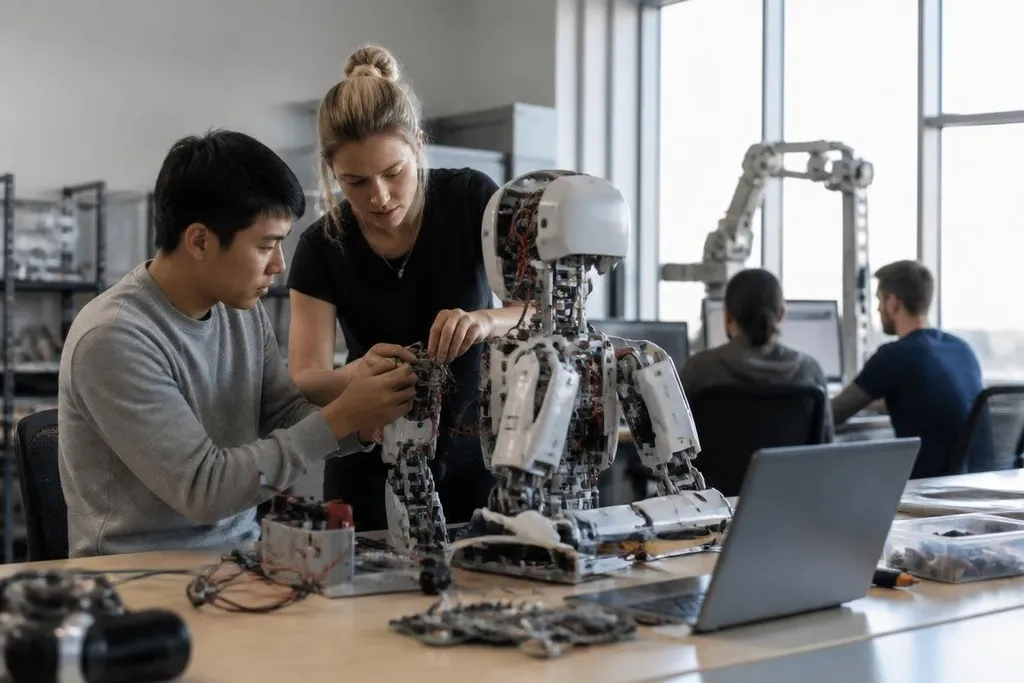
A robotics company can buy motors, cameras, and compute hardware from many suppliers. Finding people who can turn those parts into a safe working system is harder.
The competition reaches across robot makers, factories, research labs, and software teams. For a hiring manager, the question is practical: which skills are scarce, and what can your company offer besides a job title?
- Robot work joins mechanical design, software, controls, and safety.
- A strong candidate may choose a lab, a startup, or a factory team.
- Pay matters, but access to real machines can matter just as much.
Why robotics needs mixed skills
A robot project rarely fits one job description. Mechanical engineers design links and joints. Controls engineers tune motion. Software engineers connect sensors, planning systems, and motor drives. Safety engineers check what happens when a sensor fails or a person enters the work area.
That mix creates a hiring problem. A person may know robot operating system 2 (ROS 2) but lack experience with factory wiring. Another may understand machine vision but have never tuned a servo loop. A third may build a good arm but miss the service work needed after installation.
The work also changes as a project moves from a lab to a customer site. A research team may value a new grasping method.
A factory team may care more about cycle time, fault recovery, spare parts, and training for technicians. Companies need people who can move between those demands.
Where the competition shows up
Robotics companies compete for talent with places that offer different kinds of work. A university lab may give a researcher time to publish. A large manufacturer may offer access to production lines and long equipment programs. A small company may give one engineer ownership of a robot through prototype work and field service.
Location adds another factor. Moving across borders can bring visa delays, tax questions, and limits on access to controlled technology. Remote work helps with software tasks, but it does little for someone who needs to test a gripper beside a robot arm.
Training pipelines matter too. A company can hire a person who already knows LiDAR, force sensing, or embedded control. It can also hire someone with strong electrical or software skills and teach the robot-specific parts. The second route takes time, but it widens the group of people worth considering.
The skills worth hiring depend on the machines a company plans to run. Robotics news on machines and projects can connect those hiring needs to the work ahead, before the discussion turns to pay and training.
What companies can offer
Salary remains part of the decision. It isn't the whole decision. People also compare the machines they will touch, the problems they will own, and the quality of the team around them.
A clear role description helps. “Work on autonomy” tells a candidate very little. “Build and test camera-based bin picking in ROS 2, then measure failed picks on the production cell” gives them a real task to judge.
The same detail helps companies hire better. A manager can ask how a candidate would log sensor faults, test a motion planner, or set safe limits for a collaborative arm. Those questions reveal useful work more clearly than a list of broad skills.
I’d choose a team with working hardware and a clear test plan over a grand title attached to a slide deck.
A practical hiring checklist
Use these points before opening a robotics role:
- Name the machine or system the person will work on.
- List the tools they must know, such as ROS 2, C++, Python, or a PLC system.
- State whether the work happens in a lab, factory, customer site, or office.
- Explain how the team will measure progress: cycle time, fault rate, position error, or another clear result.
- Explain how prototype work connects with service, repair, and operator training.
This list also gives candidates a way to compare offers. A role with a lower salary may still fit if it offers direct machine access, clear ownership, and time to build missing skills. A higher salary may not help if the work stays far from the robot and its users.
The global contest for robotics talent will keep shifting as projects move from research benches into factories and public spaces.
Companies that describe the real work, give people access to machines, and train across disciplines will have a better chance of keeping the people who can make those systems run.